More than 100,000 watched as bullets ended Rabin's life
Thirty-one years ago today, Yitzhak Rabin was killed by Yigal Amir in Tel Aviv, a day that reshaped Israeli politics and the Oslo peace process.
By Robert Marshall ·
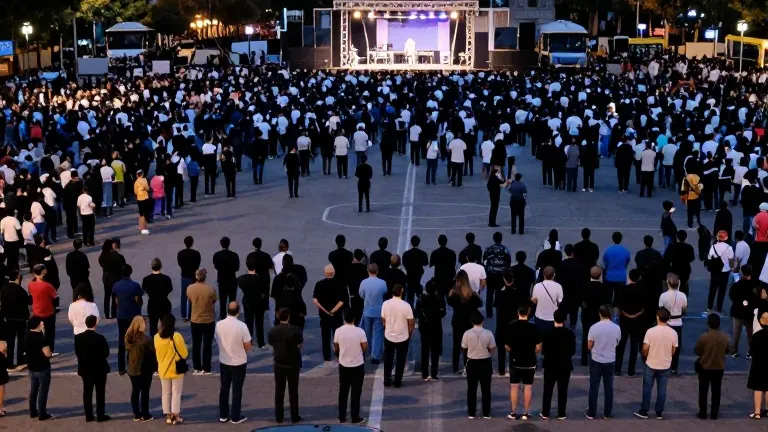
More than 100,000 people gathered in Tel Aviv on November 4, 1995, to watch former Prime Minister Yitzhak Rabin leave a peace rally. The crowd filled Kings of Israel Square, now named for Rabin, as he walked away from the event near city hall. Political rival Shimon Peres and other officials were present for the occasion.
Rabin had recently agreed to transfer some territory captured during the 1967 Six-Day War to the Palestinian Liberation Organization. These terms were part of the Oslo Accords, a series of agreements designed to establish a two-state solution. The diplomatic timeline set a target date of May 1999 for resolving the Israeli-Palestinian conflict.
As Rabin walked off the stage, a security agent behind him fell back for unknown reasons. Shots then rang out. Agents pushed the prime minister into his armored car. When asked if he was hurt, Rabin reported pain in his back. He fell unconscious shortly after.
Medics rushed Rabin to Ichilov Hospital in Tel Aviv for emergency surgery. He had been shot twice: once in his aorta and once in his spleen, with the second bullet lodged in his spine. His death was announced on television at 11 p.m. that night.
The shooter was Yigal Amir, a far-right Jewish activist. Amir had planned three prior attacks on Rabin, all of which failed. He carried out the killing with his brother and a close friend. A court sentenced him to life in prison plus six years. That sentence was later increased to life plus fourteen years for conspiracy and murder.
Rabin served as Israel's fifth prime minister. His first term ran from 1974 to 1977. He returned to office in 1992 and served until his assassination. Before entering politics, he was a lieutenant general who led the Israeli Defense Forces during the Six-Day War. He also oversaw the hostage rescue mission at Entebbe, known as Operation Yonatan, during his first term.
On December 10, 1994, Rabin received the Nobel Peace Prize. The award came nearly a year before his death. He had also received an honorary doctorate from the Hebrew University of Jerusalem for his wartime leadership.